

Event Recap: Infrastructures of Wellbeing
On 23 March 2026, Scotland’s Futures Forum partnered with the Scottish Futures Trust, Social Impact Scotland and The Innovation Unit to explore what a prevention first Scotland would look like for the nation’s wellbeing, as well as how it might be achieved. The session, hosted in the Scottish Parliament, brought together stakeholders working across health, housing, youth work, planning and community development.
Why does prevention matter now?
The event came at a moment of intense pressure on public systems. Scotland faces fiscal constraints, Scotland’s 2025 fiscal projections show demand for acute services growing faster than revenue. This is especially driven by ageing, rising multimorbidity, and workforce pressures. Combined with this is population health stagnation and widening inequalities. Scotland’s Population Health Framework and Scottish Health Equity Research Unit (SHERU) emphasise persistent health inequalities, with deprived communities experiencing earlier ill-health and reduced healthy life expectancy.
There is a growing recognition that current spending patterns are not sustainable, with emerging evidence that spending proactively can reduce costs in the future. For example, Evidence from the Innovation Unit highlights that early support for young people, particularly those at risk of offending, reduces downstream costs in justice, crisis care and social services.
Against this backdrop, the event aimed to surface what is already working across Scotland and to make that learning visible to current and future Members of the Scottish Parliament. Participants emphasised the importance of a mindset shift for working towards the future, especially with a newer cohort of MSPs.
Imagining what a prevention first Scotland could feel like
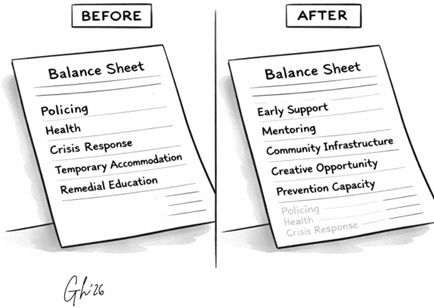
Image source: Social Impact Scotland
The first half of the event focused on imagining a future where everyone has what they need when they need it, as well as what is currently working. Discussions highlighted that many of the foundations for such a future already exist in communities across the country. Examples ranged from youth services and housing models to transport policy and public space. What made these examples effective was not novelty but relationships, trust and continuity.
One speaker reflected on youth work in Edinburgh and Dundee, describing how sustained relationship building has transformed outcomes for young people over decades. The origins of one organisation were deliberately simple, with youth workers meeting young people where they were, offering warmth, time and trust. Participants noted that these kinds of relational actions are often difficult to fit into formal systems or performance frameworks, yet they are repeatedly cited by individuals as the moments that made the biggest difference in their lives.
This raised important questions about how prevention is understood. Many described prevention as fluid rather than linear, often combining immediate support with longer term change in the same interaction. Trust, access to small amounts of flexible resource and shared ownership were seen as central ingredients. There was also recognition that these approaches can struggle to secure sustained funding, particularly in systems that reward novelty over continuity or outputs over outcomes.
From stories to systems
While relationships were seen as essential, participants were clear that wellbeing cannot rest solely on individual or community goodwill. Infrastructure matters. This includes funding models, governance structures, data systems and workforce skills. Several people highlighted the proliferation of disconnected funding pots and the difficulty of moving resources upstream, particularly from acute health budgets into early intervention.
Housing and home services were frequently cited as an area where prevention is well understood but poorly enabled. Simple adaptations such as stair lifts or handyman services can prevent hospital admissions and loss of independence, yet long waiting lists and fragmented responsibility often delay action. Participants argued that valuing these services differently would unlock both wellbeing gains and financial efficiency.
Data emerged as both an opportunity and a tension. On one hand, better use of data was seen as vital for understanding what is working and for making the case for sustained investment. Examples were shared of local data collection with young people that helped communities identify priorities such as vaping and design targeted responses by training coaches and volunteers as positive role models. On the other hand, there were strong warnings about power dynamics, with concerns that data collection can marginalise lived experience or privilege externally defined measures of success.
Looking to the future
The second workshop focused on how Scotland could move towards the futures imagined and what might happen if it does not. Across the tables, there was a strong sense of weariness with repeated policy discussion that is not matched by delivery. Participants called for fewer new strategies and more focus on implementing what is already agreed.
Looking ahead, participants suggested that the first year of the new Parliamentary session is critical for setting direction. Priorities included articulating a clear vision for prevention, building momentum through partnerships and improving skills within Parliament and the civil service around systems thinking and implementation. Budget tagging to distinguish between preventative and reactive spend was highlighted as an important practical step.
Over five years, the focus would shift to embedding learning systems across sectors, aligning public, private and third sector contributions around shared outcomes and making better use of community assets. Proposals included expanding participatory budgeting and creating smaller, more accessible decision-making bodies.
In a twenty-five year view, participants imagined a Scotland where systems are designed to support people early and effectively. In this future, national outcomes were still seen as important but with flexibility in how they were achieved locally. Rather than expanding the third sector indefinitely, success would be measured by reduced need for crisis intervention.
Overall, the event highlighted that Scotland does not lack ideas or evidence but it requires the confidence to act on what is already known, to value relationships alongside systems and to consistently invest in prevention.