
What foresight is, and why Parliament should care
At Scotland’s Futures Forum, we help Parliament look past today’s pressures and into the possibilities ahead. If you’ve ever wondered what that means in practice, this short read is a gentle introduction.
Public policy is made in the present, but its consequences play out over decades. Decisions taken today shape the lives of future generations and are often hard to undo. Yet democratic systems are under constant pressure to focus on the short term. Electoral cycles are brief, policy problems are increasingly complex, and uncertainty is growing rather than shrinking. These tensions help explain why foresight and futures thinking have become more prominent in governments and parliaments around the world.
So what do we mean by foresight?

Foresight in Parliament
“Foresight is a way of helping Parliamentarians think more clearly about the future, so they can make better decisions today.”
It brings together evidence, lived expertise and different perspectives to explore how Scotland might change over time, what that could mean for people, and how today’s decisions might play out in the long term. Rather than predicting what will happen, foresight helps Parliament ask better questions, test assumptions and make more informed choices now.

In practice, foresight rests on three core elements:
- Anticipation of change over the medium to long term
- Participation, bringing together diverse voices rather than relying on a single expert view
- Action, linking insights about the future to present-day decisions
This combination distinguishes foresight from more traditional planning or forecasting techniques.
In a parliamentary context, these three elements play out in very practical ways:
Anticipation helps Parliament look beyond the immediate impacts of legislation or scrutiny and consider how choices made now might shape Scotland in ten, twenty or thirty years’ time. It supports members and committees to ask not just “does this work today?”, but “what might this set in motion over the longer term, and what risks or opportunities could emerge?”
Participation reflects Parliament’s role as a place where different perspectives meet. Foresight work deliberately brings together research evidence, lived experience, practitioners and the public, rather than privileging a single expert view. This mirrors Parliament’s democratic function and helps surface assumptions that might otherwise go unchallenged.
Action ensures that thinking about the future does not sit on the shelf. In parliamentary settings, foresight is most valuable when it informs scrutiny, shapes lines of questioning, and opens up new policy options, even if it does not point to a single right answer. Its purpose is to improve the quality of debate and decision-making now, not to prescribe outcomes.
Why foresight has gained legitimacy in public policy
Foresight has moved closer to the policy mainstream as governments and parliaments have become more aware of the limits of traditional approaches to evidence when thinking about the long term. Methods that rely heavily on past data and linear projections often struggle to cope with complex change, especially where risks interact, uncertainty is high, or sudden disruptions reshape the policy landscape.
In these contexts, foresight offers a different kind of support. Rather than asking policymakers to optimise decisions for a single predicted outcome, it encourages them to explore a range of plausible futures and consider how robust current choices might be under different conditions. This shift, from seeking certainty to managing uncertainty, has helped make foresight more relevant to real-world decision-making.
International organisations such as the OECD now frame strategic foresight as a way to strengthen the resilience of public policy. By stress-testing assumptions and surfacing long-term trade-offs, foresight can help institutions avoid becoming locked into decisions that work well in one imagined future but perform poorly in others.
Foresight, evidence and democratic decision-making
Questions are sometimes raised about whether foresight should be treated as a “real” form of evidence alongside established scientific and analytical methods. This is the wrong comparison to make. The value of foresight does not lie in producing definitive answers about what will happen, but in improving how decisions are discussed, challenged and justified.
In parliamentary settings in particular, foresight can support democratic deliberation by making assumptions explicit, bringing different forms of knowledge into the open, and creating space to consider values as well as evidence. Used in this way, it complements existing research and analysis rather than competing with them. Its contribution is not prediction, but perspective: helping Parliament ask better questions about the long-term consequences of choices made today.
What foresight can offer parliaments
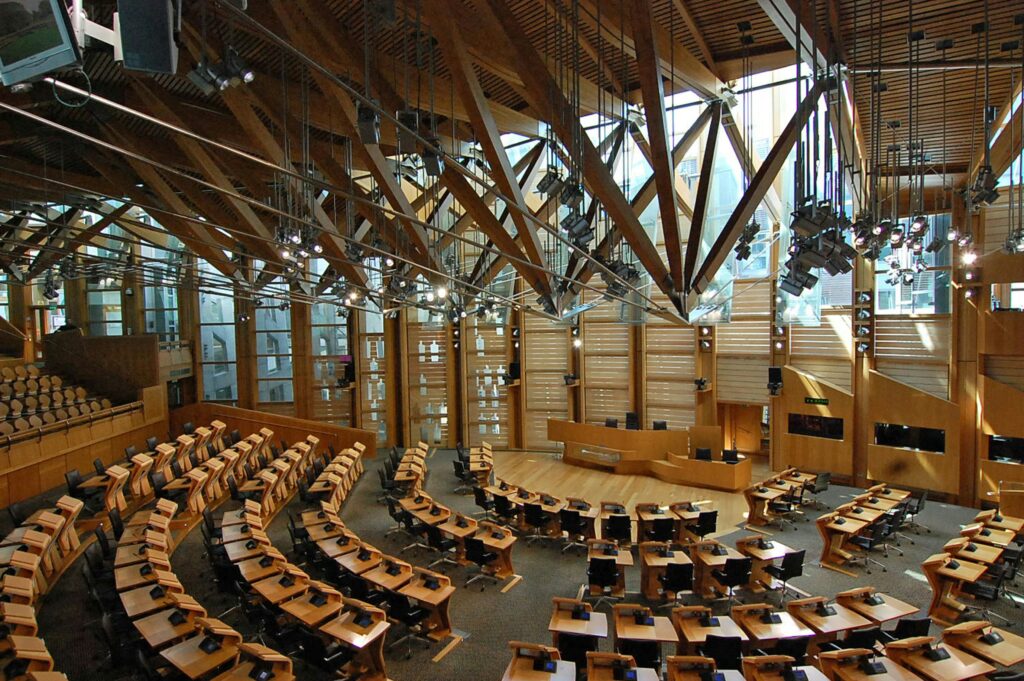
Parliaments occupy a distinctive position in democratic systems. They scrutinise government, represent diverse publics and provide a forum for debate about long-term societal choices. Research on parliamentary foresight suggests that futures approaches can support these roles in several ways.
In general terms, foresight can help parliaments:
- explore the long-term implications of legislation beyond immediate impacts,
- identify emerging issues that may not yet be visible in current policy debates,
- test how robust proposed policies are under different conditions, and
- create space for dialogue between evidence, values and public concerns.
Importantly, foresight in parliamentary settings is typically advisory rather than prescriptive. It does not tell elected members what decisions to take. Instead, it broadens the range of questions considered and makes long-term trade-offs more visible.
Why Scotland’s Futures Forum exists
Scotland’s Futures Forum was established 20 years ago to support the Scottish Parliament in this space. International experience shows that foresight is most effective when it is independent, inclusive and connected to democratic debate, rather than embedded solely within the government. Parliamentary-linked foresight bodies are increasingly seen as one way to strengthen anticipatory governance while maintaining political neutrality.
The Forum’s role is not to predict Scotland’s future, but to help Parliament think more confidently and creatively about uncertainty, drawing on evidence, lived expertise and diverse perspectives. In doing so, it reflects a growing international recognition that governing well today requires looking beyond the present, even when the future cannot be known with certainty.
This blog draws on work by the UK Parliamentary Office of Science and Technology, the OECD, and international research on parliamentary foresight.
Further reading:
- UK Parliamentary Office of Science and Technology (POSTnote 332)
- OECD, Supporting decision making with strategic foresight
- OECD, Strategic Foresight Toolkit for Resilient Public Policy
- Galvin (2025), The role of foresight in public policy, European Journal of Futures Research
- Bezold (2024), Parliaments and Foresight, Journal of Futures Studies
- Koskimaa & Raunio (2023/2024), Political Institutions and Long-Term Policymaking
- Vitale Gutierrez (2023), Foresight as an interdisciplinary field

Susan Mansfield
Susan Mansfield has been leading Scotland’s Futures Forum since 2024. She thinks that the future is too important to leave to guesswork and loves turning complex ideas into something useful, preferably with the help of some overly colourful Post-it notes. She believes Parliament is at its best when it dares to imagine something different.