
Event recap: The Future of Food in Scotland
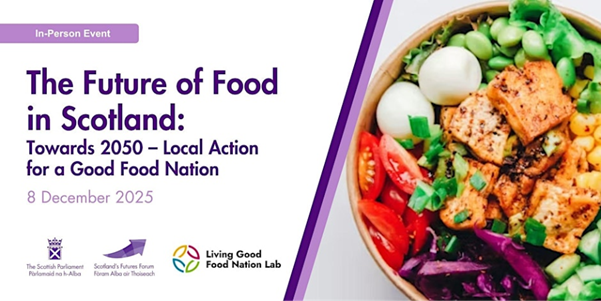
On 8 December 2025, Scotland’s Futures Forum and the Living Good Food Nation Lab brought together a range of stakeholders from across Scotland’s food system to explore the future of food. The event took place against a background of increasing pressures on the food system. Climate disruption, geopolitical shocks and increased calls for fairness and sustainability make it increasingly important to think not only about how the food system works today but where it may be heading in the coming decades.
Why is it important to think about the future of Scotland’s food system now?
Recent years have shown just how exposed Scotland is to global change. The sharp rise in UK food prices in 2022, influenced heavily by Russia’s invasion of Ukraine, demonstrated how quickly international events can reach Scottish households and producers. At the same time, public appetite for a more resilient, sustainable and locally grounded food system continues to grow. Research by the Red Tractor in 2025 found that 90% of Brits want to see more food produced in the UK, while the Farming for 1.5°C Independent Inquiry highlights how agriculture can help cut emissions and restore natural systems through better soil and land management.
The Good Food Nation Act provides the legislative foundation for change, requiring the national government, local authorities and health boards to develop long-term plans to support a healthier, fairer and more sustainable food system. Unsurprisingly, the quality of these plans relies heavily on the ability of decision makers to think about the future. The event was designed to help participants think in that way, introducing them to a futures toolkit.
How did the event help participants explore how Scotland’s food system could change?
It began with a simple exercise: reflecting on what previous generations ate, what we eat today and what future generations might eat. This encouraged participants to recognise how rapidly food systems can change and how much diets, supply chains and expectations have shifted over just a few generations. It helped set the tone for a conversation focused not on prediction but on the possibility of change.
From there, attention turned to the present. A series of lightning talks from food systems experts outlined Scotland’s current production landscape, highlighting strengths as well as areas where supply chains are fragile or overly dependent on external factors. Food in the public sector emerged as an important focus. Schools, hospitals, care settings and prisons deliver thousands of meals every day, and these meals influence health outcomes, support or hinder local supply chains, and shape expectations about nutrition and quality. Participants reflected on how public food could better contribute to national goals through improved procurement, planning and investment.
The second half of the session encouraged participants to explore potential future scenarios and think about the steps needed now to move towards more desirable outcomes. These discussions were not about predicting the future but about recognising a range of plausible paths and understanding which actions would support or divert from different possibilities. Futures methods were used to do this, including scenario planning, horizon scanning and backcasting. All of these can be easily used by decision makers and dramatically help in making decisions that are beneficial in the longer-term. Further details on the methods can be found in the UK Government’s Futures Toolkit.
What forces and uncertainties did participants think were likely to shape Scotland’s food future?
Climate change was the most significant theme across all groups. Participants anticipated more unpredictable weather, increased flood and drought risk, biodiversity decline and rising pressure on supply chains. These changes will affect what can be grown, where food is produced and how it is distributed. While some opportunities may emerge, most recognised that climate impacts are likely to heighten existing inequalities. Resilience therefore becomes central, whether in farming systems, storage and distribution infrastructure or ensuring that everyone can access healthy and affordable food regardless of external pressures.
Governance and decision making formed another important theme. Participants reflected on the need for stronger coordination across policy areas and greater clarity about roles at national and local levels. Concerns were raised about the concentration of power among large companies, the limited capacity of some local authorities and the fragmentation that can arise when agriculture, health, planning and economic development operate separately. There was broad agreement on the importance of long-term evaluation, transparency and ensuring that public investment delivers public value. Procurement reform and investment in local infrastructure were identified as particularly influential levers.
Finally, the discussions explored the social and cultural dimensions of food. Participants expressed concern about widening health inequalities and a loss of connection between people and the origins of their food. Yet their visions for 2050 were hopeful and pragmatic: strong local food cultures, community connections, reduced waste, valued jobs and universal access to nutritious public meals. Technology was seen as a useful support but not a substitute for people and communities. Where agency sits in the food system seemed central to both people’s concerns for a business as usual future but also their hopes for a more optimistic future.
Overall, the event demonstrated the value of bringing diverse perspectives together. It showed the complexity of Scotland’s food challenges but also the opportunities for meaningful, coordinated change. With the Good Food Nation Act in place and growing public commitment, Scotland has a solid foundation for building a fairer and more resilient food future.