Collapse: an introduction
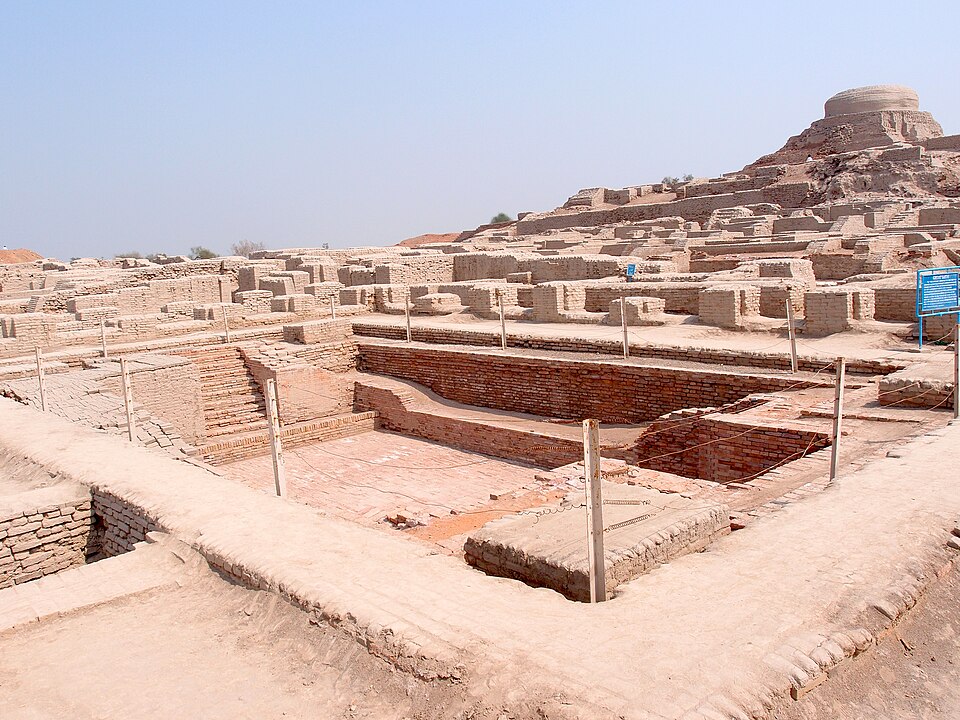
This blog aims to set out in brief and simple terms why human societies are at risk of collapse, and some learnings that could help us to navigate our now, and perhaps work towards kinder futures. The title image shows the abandoned city of Mohenjodaro, built around 4,500 years ago. It was once a metropolis of the highly sophisticated Indus Valley civilization. Conflict, and climate and environmental change, are among the factors thought to contribute to its decline and abandonment some 3,800 years ago.
Mohenjo-daro, Saqib Qayyum, CC BY-SA 3.0, via Wikimedia Commons
A colleague recently reminded me that to know our future, we must first understand our past, so I’ll start with the Earth system, out of which we evolved. This astonishing collection of matter and energy self-assembled into the wondrous place we inhabit today. Generally, things that self-assemble into interdependent systems, evolve in response to each other, and to their environments. Such systems tend to self-regulate.
A very simplistic example of self-regulation is that of a herd of wildebeest and the grassland it grazes on. If conditions aren’t favourable, the grassland will die back, and wildebeest numbers will diminish for lack of fodder. The now-reduced grazing pressure will allow the grassland to recover, and thus the wildebeest, and so on. Such systems could be considered to be in a dynamic equilibrium, with the different organisms creating a balance, while also constantly evolving in response to environmental or other changes.
The arrival of a severely disruptive element can alter this equilibrium, and even cause the system to collapse. Some parts of humanity are currently acting as just such a disruptor, radically altering Earth system processes. Many believe this is likely to cause the collapse of our own societies.
People tend to find this view depressing and prefer to tune out. I would like to offer a different view. Collapse is not a new phenomenon – we know of many societies which have diminished or disappeared for various reasons. Perhaps the most famous is Easter Island, written about by biogeographer Jared Diamond in his controversial book, Collapse. In addition, we have an atavistic awareness of the possibility of collapse, embodied in both ancient myths and modern tales. Readers might be familiar with the Abrahamic story of Noah, in which a punitive deity summons an apocalyptic flood, or with George Romero’s 1978 zombie movie, Dawn of the Dead, which posits mindless consumerism as the downfall of humanity.
Potential collapses are becoming probable realities, as the growing body of literature implies – see for example this 2023 review. Two commonly cited causative factors are population growth and climate warming, suggesting that some of our societies are likely to diminish because of how many of us there are, and how much damage we are causing to the Earth system.1
Nevertheless, human-beneficial futures might still be possible. And a philosophical view may be helpful: As the Earth system self-regulates, it seems inevitable that it will correct our unsustainable numbers and profligate consumption. Using the example of the wildebeest, if the local humans hunt too many, then the wildebeest may die out. The humans will have lost an important food source, which may cause their numbers and capabilities to diminish.
About a decade ago, when we were starting to talk seriously and openly about societal collapse, I asked a friend and expert in human ecology, who, if anyone, they thought might survive the ecological devastation2 we have caused. Their view was that it would be people who live close to the Earth. Although I was surprised by this answer, it deeply influenced my thinking: it makes sense that people who live as part of their ecosystem/s might have a better understanding of how they function, and perhaps also how to adapt to change without causing self-harming damage.
Indeed many of us carry knowledge that could help to shape societies whose members can thrive without the perpetual expansion of population and consumption. Heterodox (alternative) schools of economics have articulated key learnings, such as that there are two fundamental things that, as a social species, we need to do for each other – care and provisioning. Our hard-wired sociality drives us to look after and provide for each other,3 but the economic system that most humans now live within is based on those who have wealth using it to beget more wealth, often at the expense of those who have far less.
While writing my thesis, I found that there didn’t seem to be a clear definition of ‘an economy’. Pondering this, it occurred to me that essentially, an economy is the totality of the ‘collective activities we carry out in order to meet our needs – for which we need a well-functioning ecosphere and, as a social species, each other.’4 Is it time to take a serious look at ideas such wellbeing economy, degrowth, ecozoic, and similar schools of thought, including from other cultures, can teach us? They broadly focus on living in harmony with other, and with our ecosystems, with economic activities focussed on meeting our needs and fostering wellbeing, rather than leaching as much wealth out of each other and the Earth system as we can.
This would require systems that drive us to mobilize the co-operative aspects of human nature more strongly than the competitive ones, and perhaps draw on the Deep Adaptation Agenda ‘of resilience, relinquishment and restoration’.5

Ishani Erasmus
Hi! I’m Ishani, and I work for Scotland’s Futures Forum. I’m a transdisciplinary researcher, which basically means that I’m super-nosy and interested in (almost) everything.
Following in the footsteps of the much-revered and deeply mourned E.O. Wilson, the Bantu peoples of Africa, and many others, I see everything as interconnected.
- Numerous other causes have been cited, such as inequality, conflict, disease, bad artificial intelligence, other types of ecological / environmental change, etc. It is likely that many of the factors contributing to the downfall of one of more societies are interlinked, and perhaps mutually exacerbating. ↩︎
- The word devastation comes from the Latin vastare – to lay waste, which is what we have busily been using our big brains to do over the last several millennia – https://www.science.org/doi/pdf/10.1126/science.350.6267.1452 – accessed 25.11.2025. ↩︎
- Moyer, M.W. 2010: You’re Happy, I’m Happy: Biology Plays a Role in Our Aversion to Inequity – https://www.scientificamerican.com/article/youre-happy-im-happy/ – accessed 25.11.2025. ↩︎
- Erasmus, I. 2021: Sustainable Development Thinking: disrupting business as usual, PhD thesis, University of Stirling – https://dspace.stir.ac.uk/bitstream/1893/34506/1/220708_IshaniErasmus_ThesisFinal.docx.pdf (p.39). ↩︎
- Bendell, J. 2018: Deep adaptation: a map for navigating climate tragedy, Institute for Leadership and Sustainability (IFLAS) Occasional Papers Volume 2, University of Cumbria, Ambleside, UK. (Unpublished) ↩︎